How digital credentials work
You already use credentials every day: a driver's license, a university diploma, a gym membership card, a work badge. Each one is a piece of paper or plastic that says something about you, and that someone else trusted enough to give you.
A digital credential is the same thing, but on your phone. This page explains how they work, with no technical background needed.
The problem with paper and PDFs
Paper documents and scanned PDFs have a few problems:
- They're easy to fake. A convincing copy of a diploma or a payslip takes minutes to make.
- Checking them is slow. To be sure a diploma is real, an employer has to email or phone the university and wait.
- You share too much. To prove you're over 18, you hand over an ID card that also shows your name, address and exact birth date.
- Your data gets copied everywhere. Every company that checks your documents keeps its own copy, and each copy is another chance for a data leak.
Digital credentials fix all four.
Three roles: issuer, holder and verifier
Every digital credential involves three roles:
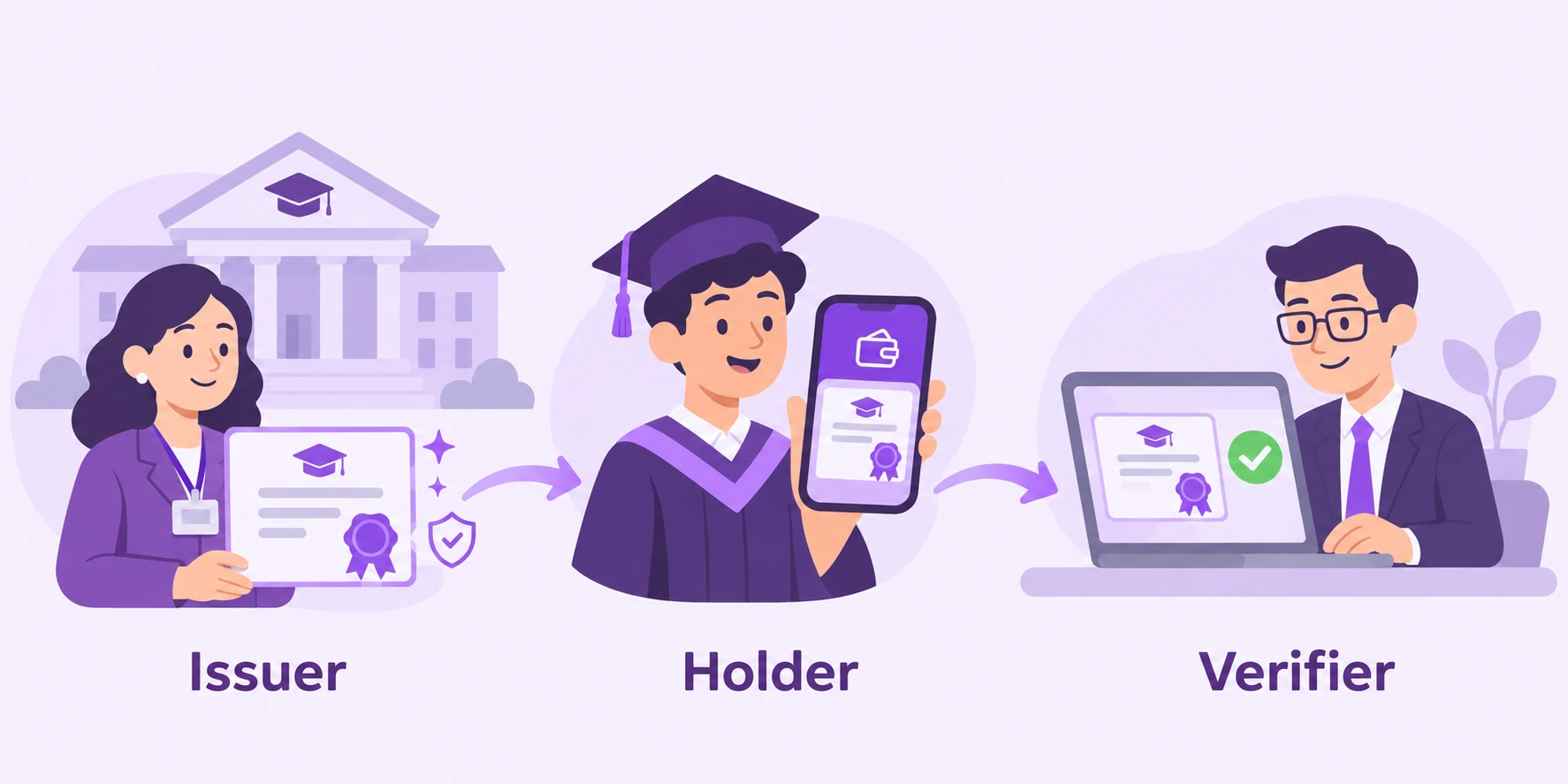
- The issuer is the organization that vouches for something: a university for a degree, a company for employment, a government for an ID.
- The holder is the person the credential is about. They receive it, keep it and decide when to share it.
- The verifier is whoever needs to check it: an employer, a bank, a shop checking age, a building checking access.
The employer never has to contact the university. The digital seal is enough to prove where the diploma came from and that nobody changed it.
The same organization can play different roles. A company can issue employee badges and also verify the certificates of people it hires.
Your digital wallet
A digital wallet is an app on your phone that works like the wallet in your pocket: it holds your credentials, and you decide which one to take out and show. The Hovi Wallet is one, and Hovi also works with other wallets.
Unlike a physical wallet, a digital one can share just the part that's needed. To prove you're over 18, you can share "over 18: yes" without revealing your name or birth date.
Why you can trust a digital credential
When an issuer creates a credential, it adds a digital seal. Think of a wax seal or a hologram, but made with mathematics instead of wax, so it's practically impossible to copy.
- If anyone changes even one letter of the credential, the seal breaks and the verifier sees it straight away.
- The verifier can check the seal on its own, without calling the issuer.
- The issuer can cancel a credential that's no longer valid, for example a license that was withdrawn. Verifiers then see that it has been cancelled.
What "decentralized" means
In many online systems, one company sits in the middle and holds everyone's data. With digital credentials, no company has to sit in the middle: the issuer gives the credential to you, and you share it directly with whoever needs to check it. You decide what to share.
Self-sovereign identity (SSI) and decentralized identity are names for this idea: you own and control your credentials. Verifiable credential is the technical name for a digital credential.
Ecosystems: the networks behind credentials
Digital credentials run on shared networks, which we call ecosystems, such as EU Digital Identity, Microsoft Entra, cheqd, Indicio and Polygon. Think of them like payment card networks: they all do the same basic job, but in different places and with different rules.
Organizations choose an ecosystem when they set up Hovi, usually based on where their users are and which wallets they use. Hovi handles the technical details. See Compatibility for more.
Where Hovi fits
- Organizations that issue or check credentials use Hovi Studio with no code, or the Hovi Connect API to build it into their own product.
- People who receive credentials keep them in the Hovi Wallet or another compatible wallet.
- Apps that want to hold credentials for their users use the Cloud Wallet SDK.
New to Hovi? The Quick start walks you through issuing and verifying your first credential.
Want the technical details?
These pages go deeper, for readers who want to know how it works under the hood:
- Credentials and Verifications: the full lifecycle, including revocation
- Credential formats: SD-JWT, mDoc, JSON-LD, AnonCreds and JWT-VC
- Decentralized identifiers (DIDs): how issuers are identified
- Communication protocols: how credentials travel between wallets